
Human Cys-C(Cystatin C) ELISA Kit ELK11040 96T
Key Features
- Assay Type: Sandwich ELISA
- Sensitivity: 2.47 ng/mL
- Detection Range: 3.13 – 200 ng/mL
- Sample Types: Serum, Plasma, Tissue Homogenates, Cell Lysates, Cell Culture Supernatants, Biological Fluids
- Detection Method: Colorimetric (450 nm)
- Available Formats: 48 Tests / 96 Tests
- High specificity with minimal cross-reactivity
- For Research Use Only (RUO)

Description
Human Cystatin C (Cys-C) ELISA Kit – ELK11040
The Human Cystatin C (Cys-C) ELISA Kit (Cat. No. ELK11040) is a highly sensitive and reliable sandwich enzyme-linked immunosorbent assay developed for the quantitative detection of Human Cystatin C in biological samples. Cystatin C is a cysteine protease inhibitor widely studied in biomedical research for its role in renal function, inflammation, and metabolic regulation.
This ELISA kit provides a convenient and reproducible platform for detecting Cystatin C concentrations in research samples. Using high-affinity antibodies and optimized reagents, the assay delivers precise measurement across a broad concentration range, making it suitable for molecular biology, biomedical, and pharmaceutical research applications.
Key Features
High Analytical Sensitivity
The assay offers excellent detection sensitivity with a limit of:
2.47 ng/mL
This allows accurate detection of low concentrations of Cystatin C in biological samples.
Wide Detection Range
The ELISA kit supports quantitative analysis within the range:
3.13 ng/mL – 200 ng/mL
This broad detection range enables reliable measurement of Cystatin C levels across various experimental conditions.
High Specificity
The assay utilizes highly specific antibodies for Human Cystatin C, ensuring accurate detection with minimal cross-reactivity or interference from related proteins.
Reliable Reproducibility
The kit demonstrates strong performance consistency:
- Intra-assay precision: CV < 8%
- Inter-assay precision: CV < 10%
These parameters ensure reliable experimental outcomes across multiple assays.
Assay Principle
The Human Cys-C ELISA Kit is based on the sandwich enzyme immunoassay technique:
- Microplate wells are pre-coated with antibodies specific to Human Cystatin C.
- Standards or samples containing Cys-C are added and bind to the immobilized antibodies.
- A biotinylated detection antibody specific to Cystatin C is added, forming an antibody-antigen complex.
- Streptavidin-HRP conjugate binds to the biotinylated antibody.
- Following addition of the TMB substrate, a color reaction develops.
- The reaction is stopped and absorbance is measured at 450 nm.
The intensity of the color is directly proportional to the concentration of Cystatin C in the sample and is quantified using a standard curve.
Compatible Sample Types
This ELISA kit is validated for detecting Cystatin C in a variety of biological samples, including:
- Serum
- Plasma (EDTA or Heparin)
- Tissue Homogenates
- Cell Lysates
- Cell Culture Supernatants
- Cerebrospinal Fluid (CSF)
- Other Biological Fluids
Proper sample preparation and storage protocols should be followed to ensure optimal assay accuracy and reliability.
Kit Components
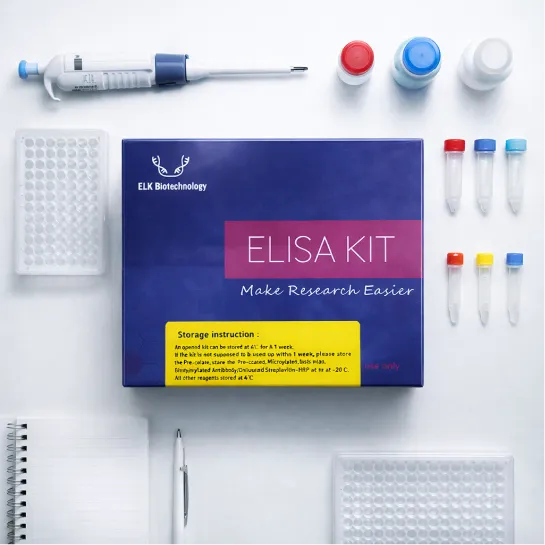
The Human Cys-C ELISA Kit includes all reagents necessary to perform the assay:
- Pre-Coated ELISA Microplate
- Lyophilized Cystatin C Standard
- Biotinylated Detection Antibody
- Streptavidin-HRP Conjugate
- Standard/Sample Diluent Buffer
- Biotinylated Antibody Diluent
- HRP Diluent
- Wash Buffer (25× Concentrate)
- TMB Substrate Solution
- Stop Reagent
- Plate Covers
All components are optimized and quality-tested to ensure reliable assay performance.
Applications
The Human Cystatin C ELISA Kit is widely used in research applications such as:
- Renal function and kidney disease research
- Biomarker discovery studies
- Inflammation and metabolic research
- Protein expression analysis
- Pharmacological and drug development studies
Storage Conditions
To maintain reagent stability and assay performance:
- Short-term storage: 4°C (up to 6 months)
- Long-term storage: −20°C (up to 1 year)
- Avoid repeated freeze–thaw cycles to preserve reagent integrity.
Important Notice
- For Research Use Only (RUO)
- Not intended for clinical or diagnostic use.