
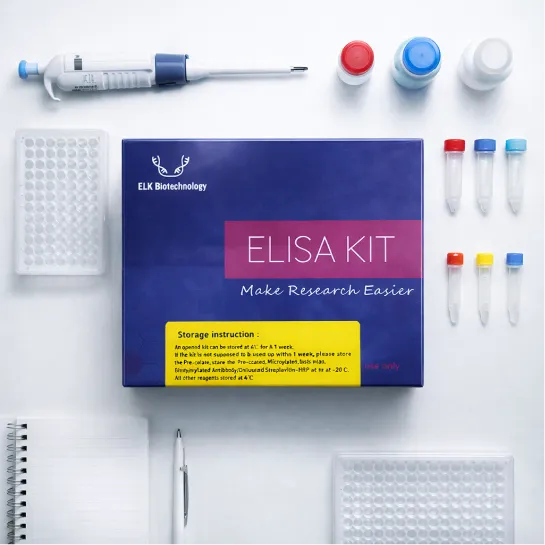
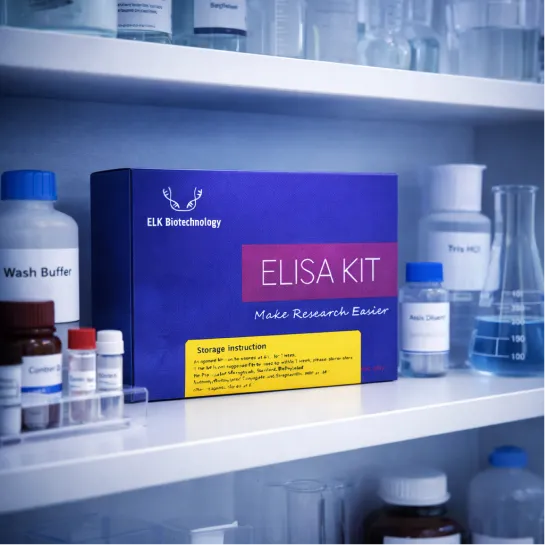

Human Cotinine (Cot) ELISA Kit – ELK0704
Key Features
- Assay Type: Competitive Inhibition ELISA
- Sensitivity: 0.6 ng/mL
- Detection Range: 1.57 – 100 ng/mL
- Sample Types: Serum, Plasma, Cell Lysates, Cell Culture Supernatants, Biological Fluids
- Detection Method: Colorimetric (450 nm)
- Available Formats: 48 Tests / 96 Tests
- High specificity and reproducibility
- For Research Use Only (RUO)

Description
Human Cotinine (Cot) ELISA Kit – ELK0704
The Human Cotinine (Cot) ELISA Kit (Cat. No. ELK0704) is a high-sensitivity competitive enzyme-linked immunosorbent assay designed for the quantitative detection of cotinine, the principal metabolite of nicotine, in biological samples. Cotinine measurement is widely used in biomedical research to evaluate nicotine exposure, tobacco consumption, and related metabolic studies.
This ELISA kit utilizes a competitive inhibition immunoassay format and provides reliable and reproducible detection of cotinine levels across a wide concentration range. The assay is suitable for use in research laboratories studying toxicology, pharmacology, metabolism, and biomarker analysis.
Key Features
High Sensitivity Detection
The assay offers excellent analytical sensitivity with a detection limit of:
0.6 ng/mL
This sensitivity allows accurate measurement of cotinine even in samples containing low nicotine metabolite levels.
Wide Detection Range
The kit supports quantitative analysis across a broad concentration range:
1.57 ng/mL – 100 ng/mL
This range enables reliable detection across diverse biological samples.
High Specificity
The assay employs antibodies specifically designed for Human Cotinine detection, ensuring high specificity with minimal cross-reactivity or interference from similar molecules.
Reliable Precision
Validated performance characteristics ensure consistent results:
- Intra-assay precision: CV < 8%
- Inter-assay precision: CV < 10%
These values confirm excellent repeatability and reliability for laboratory research applications.
Assay Principle
The Human Cotinine ELISA Kit uses a competitive inhibition enzyme immunoassay method.
- Microplate wells are pre-coated with Cotinine antigen.
- Standards or samples containing Cotinine are added together with a biotin-conjugated antibody.
- Cotinine in the sample competes with the coated antigen for antibody binding.
- Streptavidin-HRP enzyme conjugate is then added and binds to the biotinylated complex.
- Addition of TMB substrate produces a color reaction.
- The reaction is stopped and absorbance is measured at 450 nm.
Because the assay is competitive, the signal intensity is inversely proportional to the concentration of Cotinine present in the sample. The concentration is determined by comparison with the standard curve.
Compatible Sample Types
The kit is validated for cotinine detection in various biological samples, including:
- Serum
- Plasma (EDTA or Heparin)
- Cell Lysates
- Cell Culture Supernatants
- Other Biological Fluids
Proper sample collection, centrifugation, and storage procedures should be followed to ensure optimal assay performance.
Kit Components
The ELISA kit contains all essential reagents required to perform the assay:
- Pre-Coated ELISA Microplate
- Lyophilized Cotinine Standard
- Biotinylated Conjugate
- Streptavidin-HRP Conjugate
- Standard/Sample Diluent Buffer
- Biotinylated Conjugate Diluent
- HRP Diluent
- Wash Buffer (25× Concentrate)
- TMB Substrate Solution
- Stop Reagent
- Plate Covers
Each component is quality tested and optimized for reliable assay performance.
Applications
The Human Cotinine ELISA Kit is widely used in research fields such as:
- Nicotine exposure and tobacco use studies
- Toxicology and addiction research
- Pharmacokinetics and metabolism analysis
- Biomarker studies related to smoking behavior
- Environmental and occupational exposure studies
Storage Conditions
For optimal performance:
- Short-term storage: 4°C (up to 6 months)
- Long-term storage: −20°C (up to 1 year)
- Avoid repeated freeze–thaw cycles to maintain reagent stability.
Important Notice
- For Research Use Only (RUO)
- Not intended for clinical or diagnostic applications.