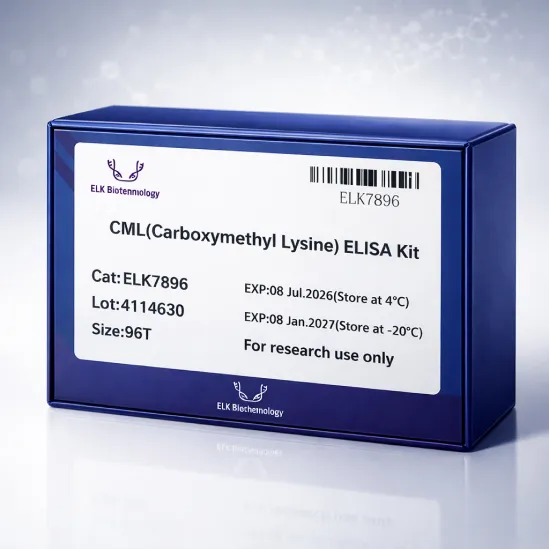
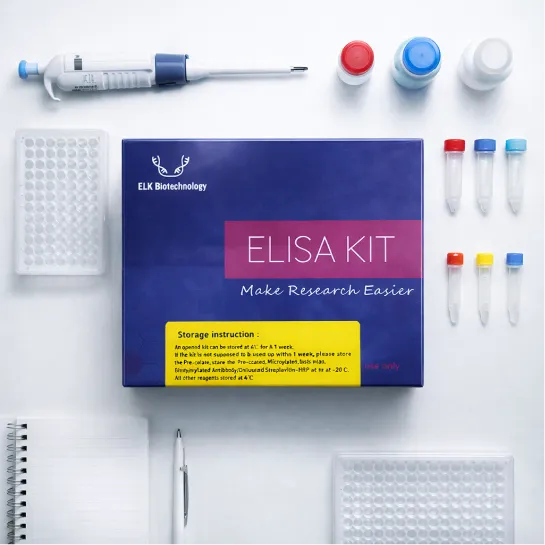
CML(Carboxymethyl Lysine) ELISA Kit ELK7896 96T
Key Features
- Assay Type: Competitive ELISA
- Sensitivity: 24.7 ng/mL
- Detection Range: 78.13 – 5000 ng/mL
- Sample Types: Serum, Plasma, Biological Fluids
- Detection Method: Colorimetric (450 nm)
- High specificity with minimal cross-reactivity
- Available Formats: 48 Tests / 96 Tests
- For Research Use Only (RUO)

Description
CML (Carboxymethyl Lysine) ELISA Kit – ELK7896
The CML (Carboxymethyl Lysine) ELISA Kit (Cat. No. ELK7896) is a high-performance immunoassay designed for the quantitative determination of CML levels in biological samples. CML is a well-established advanced glycation end product (AGE) formed through oxidative modification of proteins and lipids, and is widely used as a biomarker for oxidative stress, aging, and metabolic disorders.
This ELISA kit utilizes a competitive inhibition enzyme immunoassay technique to detect CML with high sensitivity and specificity, making it suitable for a wide range of biochemical and biomedical research applications.
Key Features
High Sensitivity Detection
The assay provides a minimum detectable concentration of:
24.7 ng/mL
This enables reliable detection of CML even at relatively low concentrations in biological samples.
Wide Detection Range
The kit measures CML concentrations across the range:
78.13 ng/mL – 5000 ng/mL
This wide dynamic range supports accurate quantification across various experimental conditions.
High Specificity
The assay uses highly specific antibodies for CML detection with no significant cross-reactivity with similar analogues, ensuring precise and reliable results.
Excellent Precision and Reliability
- Intra-assay precision: CV < 8%
- Inter-assay precision: CV < 10%
Recovery and linearity validation demonstrate strong assay performance across serum and plasma matrices.
Assay Principle
The CML ELISA Kit is based on a competitive inhibition immunoassay principle:
- Microplate wells are pre-coated with CML antigen.
- Standards or samples are added along with a biotinylated CML-specific antibody.
- CML in the sample competes with the coated antigen for antibody binding.
- Streptavidin-HRP conjugate is added to form the detection complex.
- Addition of TMB substrate produces a colorimetric reaction.
- The reaction is stopped and absorbance is measured at 450 nm.
Since the assay is competitive, the color intensity is inversely proportional to the CML concentration in the sample.
The workflow diagram on page 6 visually illustrates the competitive binding and color development steps involved in the assay.
Compatible Sample Types
This ELISA kit is validated for use with multiple biological samples including:
- Serum
- Plasma (EDTA or Heparin)
- Tissue homogenates
- Cell lysates
- Cell culture supernatants
- Urine
- Saliva
- Other biological fluids
Proper sample preparation and storage conditions are critical to ensure analyte stability and accurate quantification.
Kit Components
The kit includes all essential reagents required for assay performance:
- Pre-Coated ELISA Microplate
- Lyophilized CML Standard
- Biotinylated-Conjugate
- Streptavidin-HRP Conjugate
- Standard/Sample Diluent Buffer
- Biotinylated-Conjugate Diluent
- HRP Diluent
- Wash Buffer (25×)
- TMB Substrate Solution
- Stop Reagent
- Plate Covers
All components are quality-controlled and optimized to ensure reliable experimental outcomes.
Sample Preparation & Handling
The kit supports flexible sample preparation protocols:
- Serum/Plasma: centrifuge and collect supernatant
- Tissue Samples: homogenize in PBS and centrifuge
- Cells: lyse via homogenization or sonication
- Urine/Saliva: centrifuge to remove particulates
Samples should be stored at −20°C or −80°C if not used immediately and should avoid repeated freeze–thaw cycles.
Applications
The CML ELISA Kit is widely used in research areas including:
- Oxidative stress and aging research
- Advanced glycation end products (AGEs) studies
- Diabetes and metabolic disorder research
- Cardiovascular and renal disease studies
- Biomarker discovery and drug development
Storage Conditions
- Short-term storage: 4°C (up to 6 months)
- Long-term storage: −20°C (up to 1 year)
- Store TMB substrate in dark conditions
- Avoid repeated freeze–thaw cycles
Important Notice
For Research Use Only (RUO).
This product is intended strictly for laboratory research and not for diagnostic or therapeutic use in humans or animals.