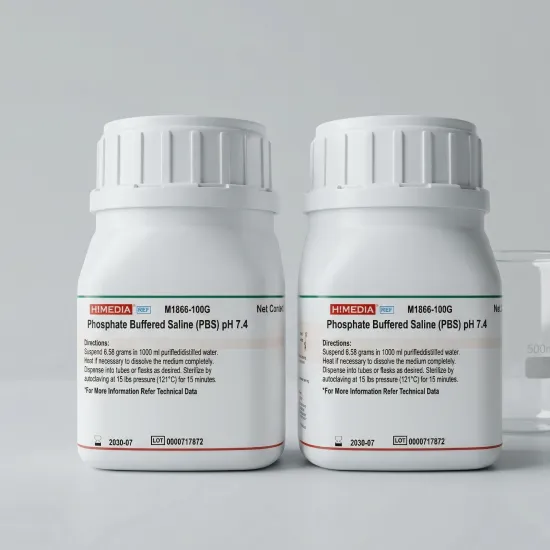
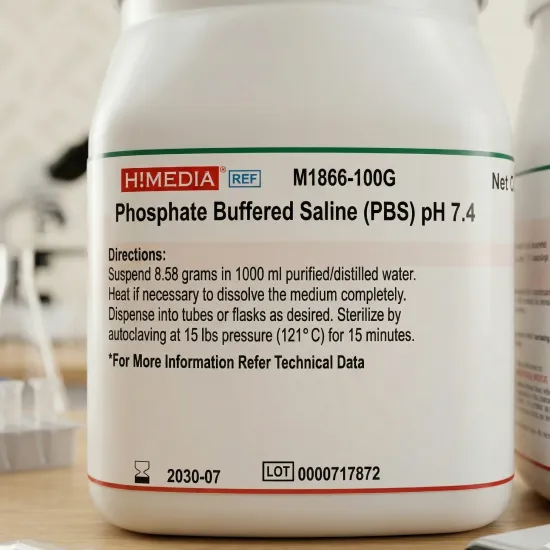
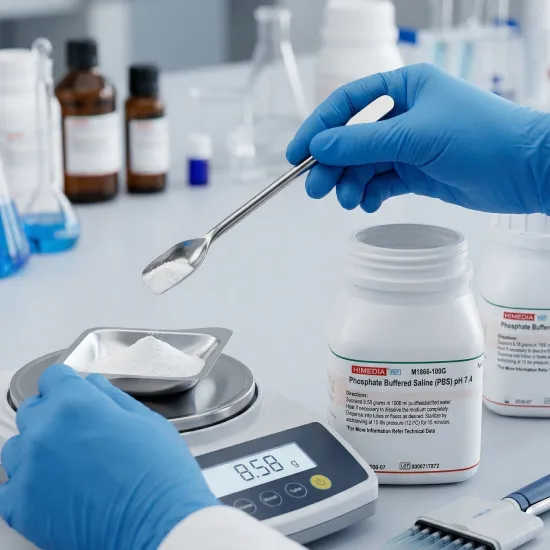
Phosphate – Buffered Saline (PBS), pH 7.4 ( M1866 )
Phosphate Buffered Saline (PBS), pH 7.4 (M1866) is a high-quality laboratory-grade buffer solution designed for sample dilution, specimen preparation, and microbiological testing. This balanced salt solution maintains osmotic balance and stable pH, making it ideal for food, water, clinical, and research laboratory applications.
Key Features
- pH 7.4 buffered saline solution
- Maintains osmotic balance and pH stability
- Suitable for clinical, food, dairy, and water samples
- Ideal for dilution and sample preparation
- High-quality laboratory-grade formulation
- Clear, colorless solution after preparation
- Easy preparation and sterilization
- In Vitro Diagnostic (IVD) use
- Storage temperature: 10–30°C
Cat No: M1866

Description
Phosphate Buffered Saline (PBS), pH 7.4 (M1866)
Phosphate Buffered Saline (PBS), pH 7.4 (M1866) is a high-quality buffered saline solution designed for sample dilution, specimen preparation, and microbiological testing. This laboratory-grade formulation maintains physiological pH and osmotic balance, making it suitable for a wide range of clinical, food, water, and research applications.
PBS is widely used in microbiology and molecular biology laboratories for preparing samples, diluting specimens, and maintaining cell integrity during laboratory procedures.
Intended Use
Phosphate Buffered Saline (PBS), pH 7.4 is used for:
- Sample dilution
- Preparation of blanks
- Examination of food samples
- Water sample analysis
- Clinical specimen preparation
- Non-clinical sample processing
This buffer solution ensures stable pH and isotonic conditions during laboratory procedures.
Composition
The formulation of PBS (pH 7.4) contains the following components:
| Ingredient | g/L |
| Sodium Chloride | 7.650 |
| Disodium Phosphate (Anhydrous) | 0.724 |
| Dipotassium Hydrogen Phosphate | 0.210 |
Final pH at 25°C: 7.4
Principle
Phosphate Buffered Saline (PBS) works by:
- Maintaining stable pH through phosphate buffering
- Maintaining osmotic balance using sodium chloride
- Supporting microbial sample preparation
PBS is commonly used as a diluent and for sample preparation, particularly for Vibrio species testing and microbiological analysis.
Directions for Use
- Suspend 8.58 grams in 1000 ml distilled water
- Dispense into tubes or flasks
- Sterilize by autoclaving at 121°C for 15 minutes
- Use after sterilization for laboratory applications
Physical Characteristics
| Parameter | Description |
| Appearance | White to cream homogeneous powder |
| Prepared Solution | Clear, colorless |
| pH | 7.4 at 25°C |
| Solubility | Completely soluble |
Applications
This PBS solution is suitable for:
- Clinical microbiology laboratories
- Food and dairy testing
- Water testing laboratories
- Research laboratories
- Sample dilution and preparation
- Microbial testing
Supported Sample Types:
- Stool samples
- Food samples
- Dairy samples
- Water samples
Storage and Shelf Life
- Store at 10–30°C
- Keep container tightly closed
- Protect from moisture and humidity
- Store in dry and ventilated area
- Avoid extreme temperature conditions
Quality Control
- White to cream powder
- Clear solution after preparation
- Stable pH of 7.4
- No precipitate formation
- Reliable performance under recommended conditions
Safety Information
- For In Vitro Diagnostic use only
- Follow microbiological laboratory safety guidelines
- Wear protective gloves and protective equipment
- Sterilize contaminated materials before disposal
Advantages
- Stable pH buffering system
- Maintains osmotic balance
- Easy preparation
- High reproducibility
- Laboratory-grade quality
- Wide application range
- Reliable performance
Product Information
| Product Name | Phosphate Buffered Saline (PBS) |
| pH | 7.4 |
| Product Code | M1866 |
| Format | Powder |
| Application | Sample Dilution & Preparation |
| Storage | 10–30°C |
| Use | In Vitro Diagnostic |
Phosphate Buffered Saline (PBS), pH 7.4 (M1866) is a reliable and essential laboratory reagent designed for consistent sample preparation, dilution, and microbiological testing across clinical, research, food, and environmental laboratories.